
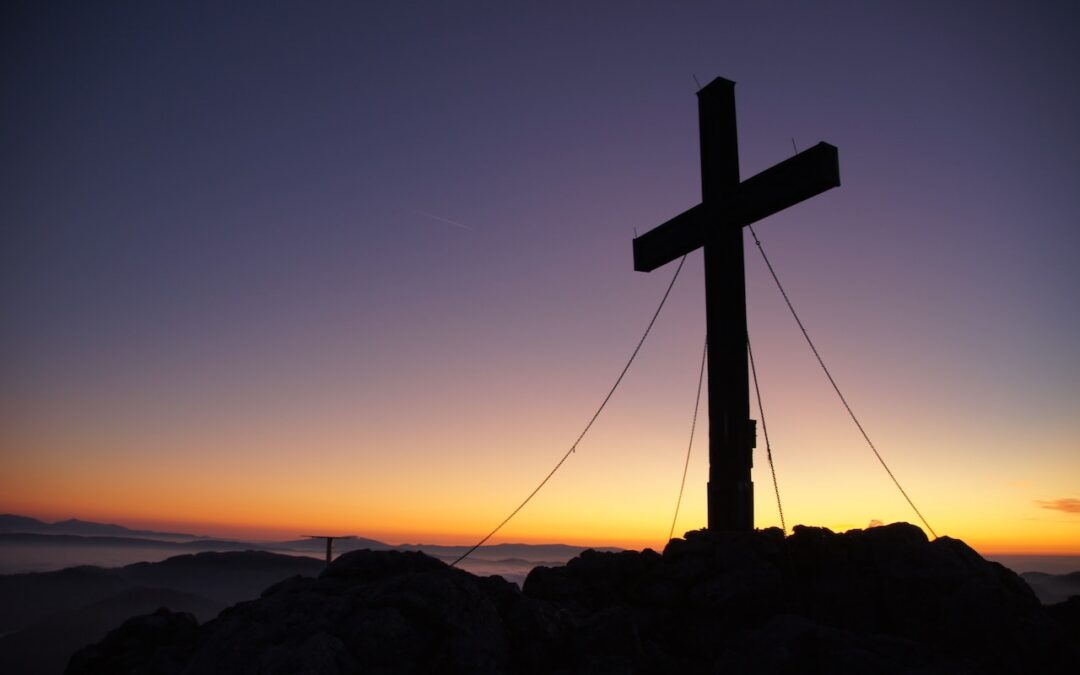
How did Jesus know that he must suffer, die, and rise again?
(Mark 9:31-32; John 19:28-30; 1 Cor. 1:17-25; Titus 1:2; Rev. 13:8) Blog Oct. 30-Nov. 5, 2022
Prepared by Richard A. Marin: Present Truth PO Box 700, Fallbrook CA 92088-0700 USA
REVIEW: Lucifer introduced pride into the universe: first in heaven, then on earth. When Adan chose to believe his lie, all humanity became subject to corruption of nature and condemnation to death. That death takes on two forms: temporal death and eternal death. The first is like an unconscious sleep. The second ends in total destruction. But even in the Old Testament, God gave the hope of resurrection from temporal death together with the hope of eternal salvation to those who believe his Word. Moses was raised to eternal life and before the cross six other people were raised to temporal life.
Before the Cross
1. What pledge did Jesus make before the foundation of this world? When Jesus & the Father were planning the creation of life on earth, they also planned a remedy should humanity fall into sin. Jesus pledged to be Substitute & Surety for the race should it fall (Zech. 6:13; Acts 3:23; 1 Pet. 1:19-20).
2. How sure was Jesus’ pledge to redeem the race should it fall? Since Jesus is God who cannot lie, his pledge to redeem humanity was as good as if he had already paid the ransom for the entire human race (Num. 23:19; Tit. 1:2; Rev. 13:8).
3. What proof of the surety of Jesus’ pledge was given in the Garden of Eden? The surety of Jesus’ pledge was demonstrated by the fact that Adam & Eve did not die the day they ate the forbidden fruit, for Jesus stepped in between justice & the guilty pair (Gen. 2:16-17; Num. 16:48).
4. What promise of victory over sin did God make in Eden? God promised a human Savior who would destroy sin & redeem the race (Gen. 3:15).
5. What emblem of Christ’s death did God give to Adam and Eve in Eden? God gave the guilty pair sacrificial animals which represented Jesus. After confessing their sins upon these substitutes they killed them & God made them coats of skin to cover their nakedness (Gen. 3:21).
6. How did John the Baptist make clear that Jesus was the fulfillment of all the animal sacrifices made through the centuries before the cross? Pointing to Jesus, John said: “Behold the Lamb of God which taketh away the sin of the world.” (John 1:29).
7. When Jesus told his disciples that he would be killed and rise again the third day, how did they react? Peter rebuked Jesus for thinking such a thing & none of the disciples really understood what Jesus meant (Matt. 16:21-23; Mark 9:30-32).
8. What kept the disciples from understanding what Jesus meant when he said he would be killed? The preconceived ideas of a conquering Messiah held by Christ’s disciples kept them from grasping the meaning of his statements (Luke 24:19-21).
9. How did Jesus know that he must suffer and die and rise again the third day? It was by diligent study of the Scriptures that Jesus came to understand his mission & destiny (Luke 18:31-34; 24:25-27, 44-46).
10. List some of the Scriptures that must have helped Jesus understand his mission of suffering, death, and resurrection: Genesis 22:8; Psalms 22:1, 5-8, 15-19; Daniel 9:24-27; Isaiah 53:1-12; Hosea 6:1-2).
On the Cross
11. When did Christ’s extreme sufferings begin? Although his life was a life of sufferings, their intensity greatly increased when the sins of the world were placed on him as he entered Gethsemane (Matt. 26:36-38; Luke 22:37).
12. Whose sins did Jesus bear as he went to the cross? Jesus bore all the sins of every human being that comes into the world (1 Tim. 2:6; 4:10; 1 John 2:2).
13. What curse pronounced on Adam did Jesus bear? Jesus bore the curse of thorns, for they were pressed into his head & beaten down with a rod (Gen. 3:18; Matt. 27:29-30).
14. How do the events just before and on the cross relate to Deuteronomy 28? The curses listed in Deuteronomy 28 include curses in the city & curses in the field, darkness at noonday, becoming a byword, thirst, nakedness, & final destruction. All these Jesus bore at Calvary (Deut. 28:16, 29, 37, 43, 48; Matt. 27:41-46; John 19:28).
15. When Jesus cried, “It is finished,” to what did he refer? When Jesus died, he completed the work his father gave him to do on earth: that of living a sinless life in our behalf & of dying for our sins. Also, by dying the second death for every person, he defeated the devil & opened the eyes of the universe to the utter evil of sin (John 17:4; 19:30; Col. 1:14; Heb. 2:14).
16. Besides abolishing death, what other great blessing did Jesus bring to humanity through the gospel? Jesus brought “life and immortality to light through the gospel.” (2 Tim. 1:10).
17. How does Luke 23:46 confirm what happens at death? Just as Solomon stated in Ecclesiastes, when a person dies the spirit returns to God who gave it, so Jesus’ spirit returned to God when he died (Eccl. 12:7; Luke 23:46).
18. When Jesus died on Calvary did that bring justification to the entire human race? No, for justification is by faith alone, the believer’s faith, not that of someone else (Rom. 5:1; Col. 1:4; 1 Pet. 1:9).
After the Cross
19. When the Sabbath was about to begin what Scriptures about Jesus’ body were fulfilled? The predictions that not a bone of his body would be broken & that his side would be pierced were both fulfilled that Friday afternoon (Psa. 34:20; Zech. 12:10; John 19:33-37).
20. What did Jesus do during the Sabbath hours after the cross? Jesus, like his disciples, rested that Sabbath. He in the tomb, they in their homes (Luke 23:53-56).
21. How does Paul use the word “cross”? For Paul the word “cross” is an abbreviation for the word “gospel,” for the cross is the high point of the gospel story (1 Cor. 1:17; 15:1-8; Gal. 6:14).
22. Why does Paul say that the preaching of the cross seems like foolishness to worldly wisdom? The cross seems like foolishness to worldly wisdom, because the cross which looks like a colossal defeat, was really a colossal victory (1 Cor. 1:17-25; Gal. 6:14; Col. 1:20).